Table of contents
Most company values are fiction. Here’s how to uncover the ones your organization actually lives by.
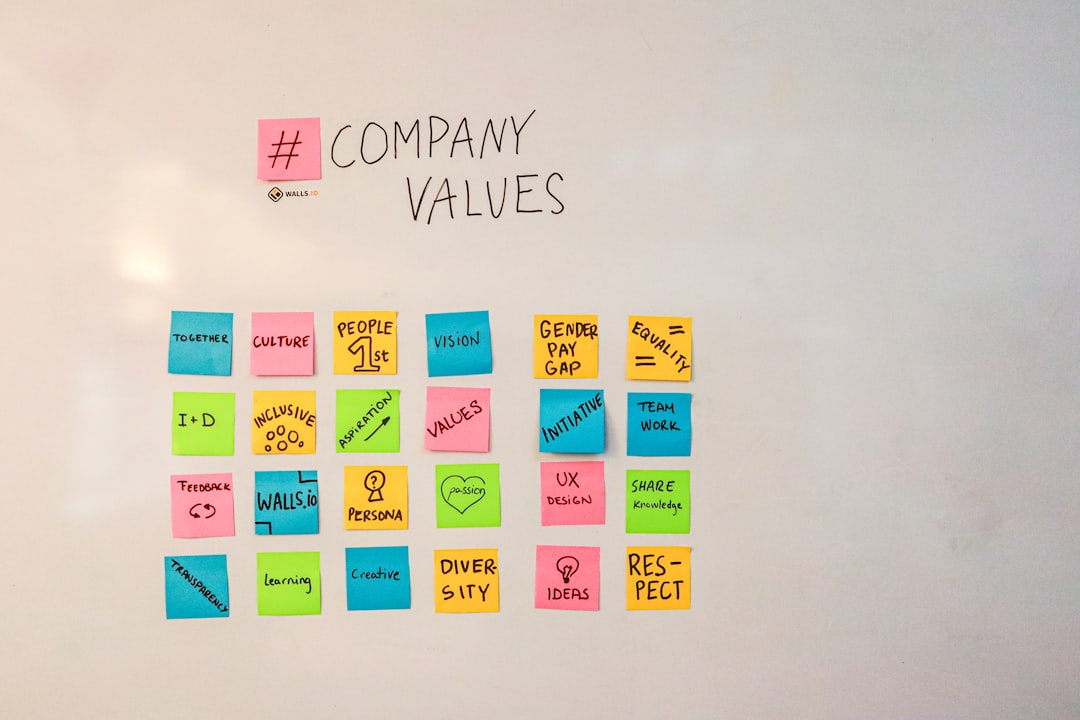 Photo by Walls.io
You’ve seen them before. Those five or six words plastered on a conference room wall. “Integrity.” “Innovation.” “Teamwork.”
They sound great. They mean nothing.
And you already know it. Because you’ve watched companies plaster “People First” on the lobby wall while burning through talent like firewood.
Here’s the thing: defining company values isn’t the problem. Every organization can brainstorm a list. The problem is that most values are aspirational fiction — what leadership wishes the culture were, not what it actually is.
In this guide, you’ll learn a research-backed method to define company values that reflect reality. Values that employees recognize. Values that drive real decisions. And values you can actually use to hire, fire, and lead.
Let’s get into it.
What Are Company Values, Really?
Before we talk about how to define company values, let’s get clear on what they are — and what they aren’t.
Company values are the deeply held principles that actually shape behavior inside your organization. Not the ones you put on the careers page. The ones that show up when nobody’s watching.
Here’s why that distinction matters:
Research from Bain & Company found that 90% of executives believe culture is as important as strategy. But fewer than 15% say their company’s culture is where it needs to be.
That gap? It’s the difference between stated values and lived values.
Stated values are what you put on the website. Lived values are what actually drive decisions about who gets promoted, how conflicts get resolved, and what happens when nobody’s looking.
The goal isn’t to invent new values. It’s to discover the ones that already exist — and then decide which ones to keep, amplify, or change.
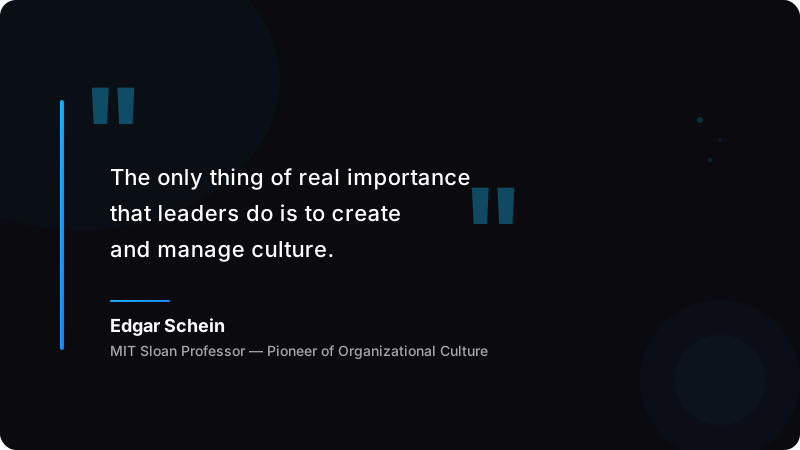
Why Most Values Exercises Fail
Let’s be direct: the traditional approach to defining company values is broken.
Here’s how it usually goes. Leadership locks themselves in a room for a day. Someone brings Post-its. Everyone brainstorms words they like. The consultant synthesizes them into five polished statements. Marketing designs a poster.
And within three months, nobody remembers what they are.
Why does this keep happening?
Three reasons.
The Executive Echo Chamber
When only the C-suite defines values, you get the C-suite’s perception of culture. Not the actual culture. Executives experience a fundamentally different organization than a mid-level manager or a new hire on the warehouse floor.
The Aspiration Trap
Teams pick values they want to have instead of values they do have. “Innovation” sounds exciting. But if your company actually rewards risk-aversion and consistency, that’s a contradiction employees will see right through.
The Survey Limitation
Even when companies try to involve employees, they typically use surveys with closed-ended questions. Check this box. Rate this statement. Pick from this list.
But here’s the deal: you can’t capture culture in a multiple-choice question.
Culture lives in the stories people tell. The decisions they describe. The way they explain why things work the way they do. That requires open-ended, probing conversation — not a Likert scale.
The 3-Phase Method to Define Company Values
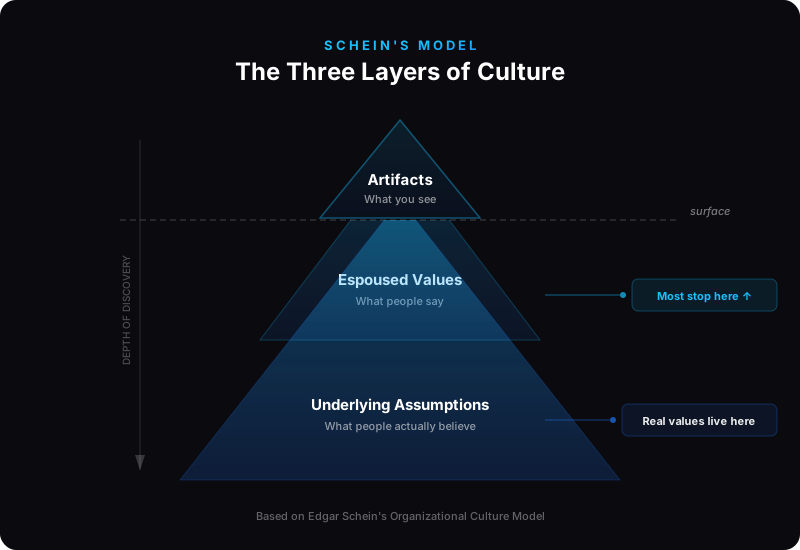
There’s a better way. It’s grounded in research by Collins & Porras (Built to Last), Edgar Schein’s organizational culture model, and Cameron & Quinn’s Competing Values Framework.
The idea is simple: triangulate what the company says, what employees experience, and what the data reveals.
Here’s how it works.
Phase 1: Desk Research — What Does the Company Say?
Before talking to a single employee, start by analyzing what already exists in the public domain.
This means systematically reviewing your company’s website copy, social media presence, Glassdoor and Indeed reviews, press coverage, job postings, and any published thought leadership.
You’re looking for patterns. What language keeps showing up? What do employees praise in reviews? What do they criticize? What does the company signal it cares about?
Map every finding against a structured value taxonomy. Think of it as a starting hypothesis: “Based on what we can see from the outside, these appear to be the values this company operates by.”
Now here’s the thing: this is just the hypothesis. It needs to be tested.
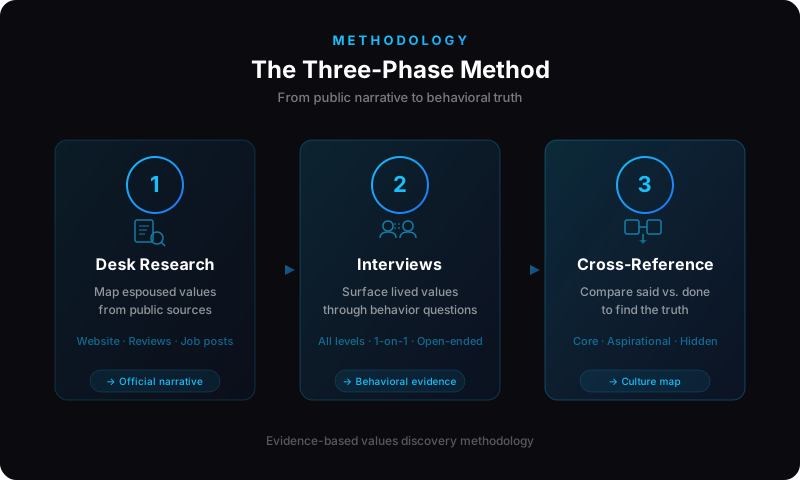
Phase 2: Employee Interviews — What Do People Actually Experience?
This is where the real insights live.
Structured behavioral interviews with a representative cross-section of your organization — different roles, seniority levels, departments, tenures — are the single most powerful way to uncover lived values.
But not just any interviews.
The key is behavioral questions. Not “What do you think our values are?” but “Tell me about a time when you had to make a tough call at work. What guided your decision?”
When people tell stories about real experiences, they reveal what actually matters. They describe the moments that defined their understanding of the culture — the decisions that got celebrated, the behaviors that got punished, and the unwritten rules everyone knows but nobody says out loud.
 Photo by Vitaly Gariev
Here’s where it gets interesting.
The challenge with interviews has always been scale. A 50-person company can do this in a week. A 5,000-person company? That’s months of work — and a consulting bill to match.
Traditional approaches force you to choose: either go deep with a handful of people (and risk missing patterns), or go broad with a survey (and miss the nuance).
But it gets better. This tradeoff is disappearing.
Odevio is an AI interviewer that conducts adaptive voice interviews at scale. Employees receive a link, complete the interview on their own time by speaking naturally on any device, and the conversation adapts in real time — probing vague answers and exploring unexpected threads.
Every interview is transcribed, themed, and ready for analysis. So instead of choosing between depth and scale, you get both.
In fact, there’s an open-source values discovery methodology on GitHub that implements exactly this three-phase process. It uses AI desk research, Odevio-powered behavioral interviews, and quantitative analysis to surface authentic company values. It’s free, research-backed, and ready to use.
Phase 3: Computation — What Does the Data Reveal?
Now you have two data sets: what the company signals publicly (Phase 1) and what employees experience privately (Phase 2).
Phase 3 is where you compare them.
This means quantitative scoring across your value taxonomy, cross-phase gap analysis, and statistical clustering to identify the 3-5 values that genuinely define your organization.
 Photo by Luke Chesser
The gaps are where the gold is.
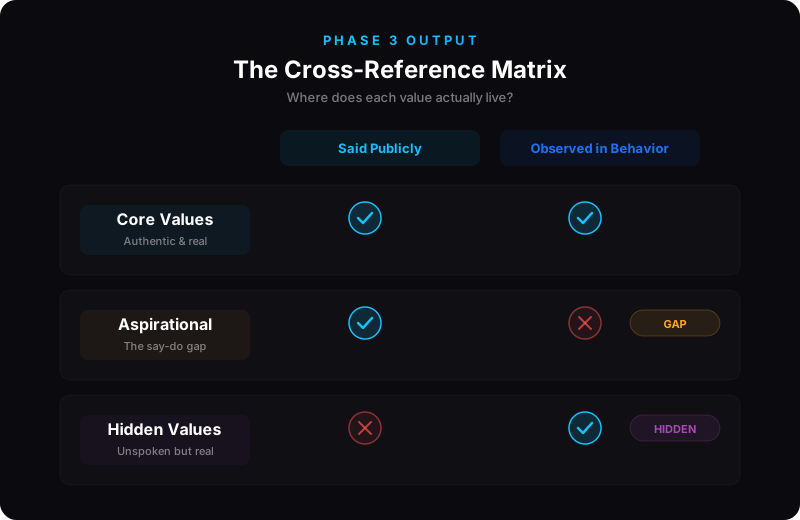
When Phase 1 and Phase 2 align — when the company says “collaboration” and employees describe collaborative behaviors in their stories — that’s a confirmed core value. It’s real.
When they don’t align — when the website says “innovation” but every employee story is about following established processes — that’s a gap. And it’s a gap you need to address, either by changing the aspiration or changing the behavior.
The output is a clear, evidence-based picture: “Here are the 3-5 values your company actually operates by. Here’s the evidence. And here are the gaps between stated and lived culture.”
Company Values Examples: What Good Looks Like
Looking at company values examples can help calibrate your expectations. But notice something about the companies known for strong values: their values are specific, not generic.
Netflix doesn’t just say “Excellence.” They say “We value people over process” and back it with a detailed culture document that describes exactly what that means in practice.
Patagonia doesn’t say “Sustainability.” They demonstrate it through supply chain decisions, employee benefits, and a willingness to tell customers not to buy their products.
The best company values examples share three traits. They’re specific enough to guide real decisions. They’re honest about tradeoffs (“We prioritize speed, which sometimes means imperfect work”). And they’re backed by organizational systems — hiring criteria, promotion rubrics, and compensation structures — that actually reinforce them.
That’s what your values exercise should produce. Not five pretty words. A decision-making framework that works.
How to Run Your Own Company Culture Assessment
Ready to do this yourself? Here’s the practical roadmap.
Step 1: Audit Your Public Presence
Spend a few hours reviewing your own website, social media, job postings, and employee review sites through the lens of values. What patterns emerge? Write down your hypotheses.
Step 2: Design Behavioral Interview Questions
Create 8-12 open-ended behavioral questions. Focus on real experiences, not opinions. “Tell me about a time you disagreed with your manager and what happened” reveals far more than “Do you feel empowered to disagree?”
Step 3: Interview a Representative Sample
Aim for at least 15-20% of your organization, ensuring diversity across roles, departments, and tenure. If you’re running this at scale, this is exactly where a tool like Odevio changes the game — making it possible to interview hundreds of people with the same depth you’d get one-on-one.
Step 4: Analyze and Triangulate
Compare your desk research findings with interview themes. Look for alignment and gaps. Cluster the findings into 3-5 core values with supporting evidence.
Step 5: Validate and Activate
Share the findings with a cross-section of employees. Do they recognize these values? Does this feel true to their experience? Then build systems — hiring rubrics, feedback frameworks, recognition programs — that reinforce the values you want to keep.
The Bottom Line
Defining company values isn’t about inspiration. It’s about investigation.
The companies that get values right don’t start by asking “What do we want to be?” They start by asking “What are we actually like?” — and they use rigorous methods to find out.
The three-phase approach — desk research, behavioral interviews, and quantitative analysis — gives you something most values exercises never deliver: evidence.
And with tools like the open-source values discovery framework and AI-powered interviewing through Odevio, you don’t need a six-figure consulting engagement to do it well.
Start with what’s real. Define values that people recognize. Then build systems that reinforce them.
That’s how you define company values that actually stick.